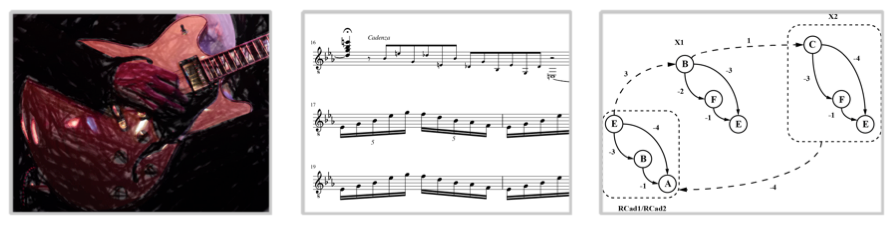
Neo-Riemannian theory in music in short describes pitch relationships between major and minor triads. It examines the effect of efficient voice leading, or in other words, what happens when one pitch of a triad changes by a tone or semi-tone. These single pitch changes are categorized into three basic triadic transformations: P=parallel, R=relative and L=leading-tone… Continue reading Neo-Riemannian Transformations/Fanfare
Tag: music theory
Gigue en Cinq
A gigue, or jig, is a type of dance that usually uses a compound meter. This piece, Gigue en Cinq, as implied in the title, uses an irregular compound meter, 5/8, resulting in an underlying beat that sounds uneven. Sometimes an irregular time signature like 5/8 or 5/4 is used for convenience, and the music… Continue reading Gigue en Cinq
Blue Blues
A hexatonic scale is any scale consisting of six pitches. There are numerous ways to construct such a scale, but some of them are used more often than others and even have their own names. The so-called tritone scale is a hexatonic scale constructed from two triads related by a tritone. For example, combining the… Continue reading Blue Blues
Phrygian Meditation
The phrygian scale is a type of minor scale similar to the natural minor (or aoelian) scale, but with a lowered second. The term phrygian as applied to music comes from the music theory of the ancient Greeks, although the Greek phrygian scale was likely different than the one used today, and was certainly used… Continue reading Phrygian Meditation
Study in Minor 2nds
This composition is a study is based on pairs of notes that are a minor 2nd, or half-step, apart. Note that all minor 2nd pairs except one involve an open string to avoid unwieldy stretches. Alternate thumb and index finger on adjacent strings to execute quickly. Play as fast as you'd like! (Please consider supporting… Continue reading Study in Minor 2nds
 Ken Pasciak